Research, design & front-end
Jan 1, 2025
Venture (Co-founder): Personalized children's stories
Co-founded Tolly, a venture building hyper-personalized children’s books powered by AI — from recruiting a senior team (ex-BCG & CS PhD), to designing & coding the MVP, to building a fully automated story + illustration pipeline tested with 100+ families. Learned how to combine team building, deep user research, and cutting-edge AI into a real product — and when to pivot.
Role
Research, design & front-end
👀 Overview
What it is: A venture to create hyper-personalized children’s books, where every kid becomes the hero of their own story — with custom names, characters, and illustrations.
Why it matters: Parents want meaningful, personal stories for their kids, but existing options are generic, expensive, and lack emotional resonance. We set out to combine storytelling, AI, and design to deliver magical one-of-a-kind books at scale.
Key takeaway: Deep dive into team building, AI product innovation, and end-to-end product execution. Built something magical that parents and kids loved — and learned when to pivot.
🎯 Objectives
Primary: Validate market demand for personalized children’s books & business model viability.
Secondary: Build an automated AI pipeline that could generate full storybooks (text + illustrations) with minimal manual work.
Additional: Explore supply chain feasibility, partnerships with kindergartens, and go-to-market strategies.
📊 Success metrics
Problem validation: 200+ in-depth interviews with parents, kids, and child psychologists.
Product: Built a fully functional AI pipeline → text + illustrations, tested with 100+ families.
Partners: First supplier partnerships + support from a kindergarten association & multiple renowned children's psychologists.

👯 Audience & messaging
Persona: Parents of children aged 3–7, looking for unique bedtime stories.
Pain points: Generic mass-market books, lack of personalization, poor design.
Key message: “Stories where your child is the hero — magical, personal, and made just for them.”
🧐 Design inspiration & style
Like: Pixar/Disney storytelling, modern D2C aesthetics (e.g., Wonderbly).
Avoid: inconsistent illustrations, weak narratives.
📆 MVP scope & timeline
Team build-up & idea validation (~3 months)
Spoke with ~100 potential co-founders → convinced eventual COO (ex-BCG) & CTO (CS PhD) to join full-time
Conducted 200+ interviews with parents, kids & child psychologists to validate demand
Created landing page & early book prototypes (Framer, Figma, LLMs & image models)
Built full brand identity (custom fonts, mascots, design system, web/app mockups)
MVP build & iteration (~3 months)
Developed automated story + illustration pipeline (multi-LLM orchestration, AI image workflows for character consistency)
Spoke with 50+ investors & prepared fundraising materials and explored in-depth non-dilutive funding alternatives
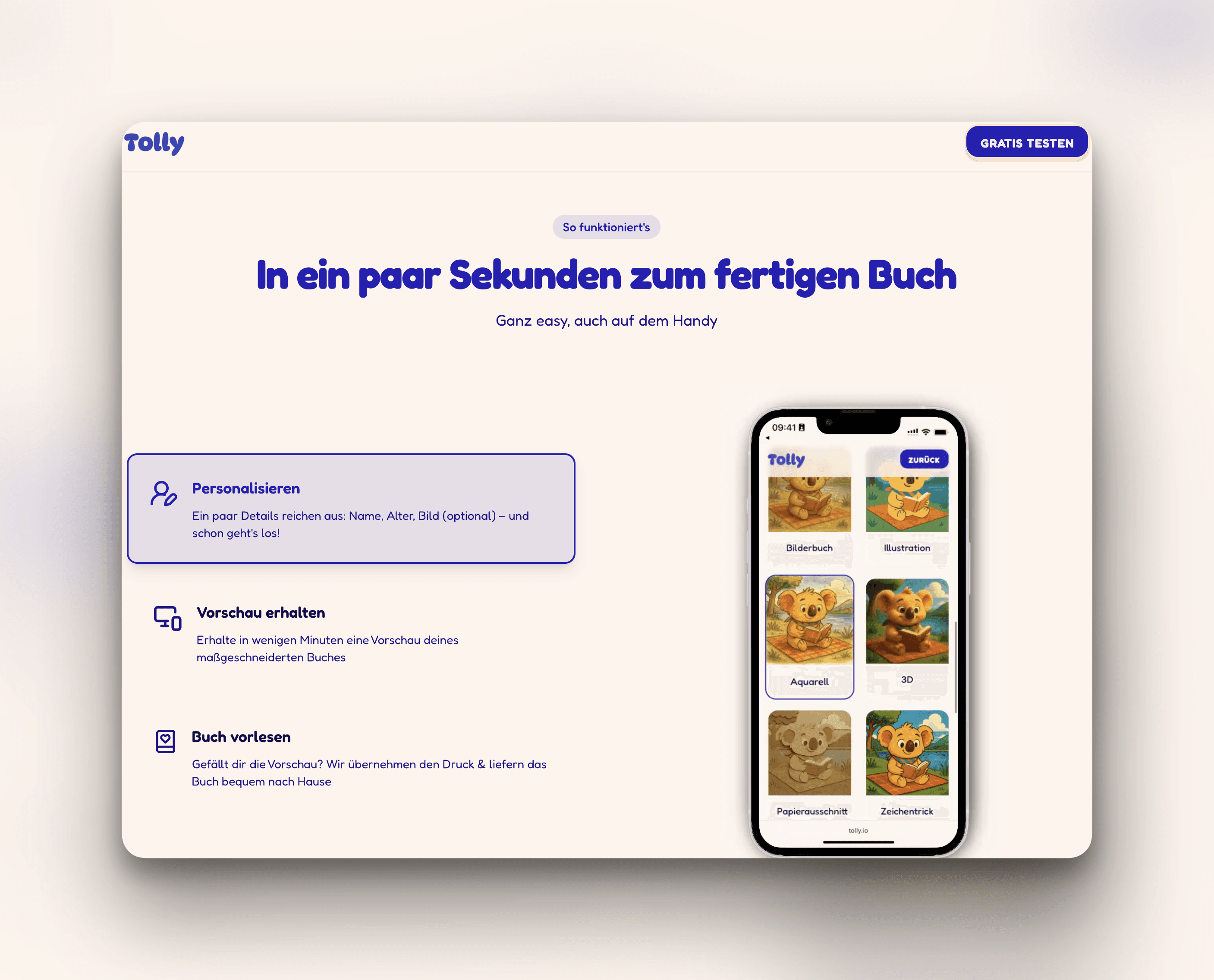
Launched beta web app with custom personalization flow
Printed & tested pilot books with families
Optimized AI flows (latency, cost, narrative quality; template-based generation)
Explored growth channels (kindergarten pilots, supplier partnerships)
🧑🎓 Outcome & learnings
Team building: Interviewed 100+ potential co-founders, convinced two senior profiles (ex-BCG & CS PhD) to join full-time.
Technical innovation: Built a fully automated pipeline concatenating LLM prompts → complete personalized storybooks. Tested multiple models for cost, latency & narrative quality. Developed image workflows for character consistency, page-to-page coherence, and better composition. Built system to adapt quickly to new models (e.g. GPT image model).
Design execution: Created a full brand system (mascots, typography, visual identity). Designed and prototyped web app, marketing site, and printed books in Figma.
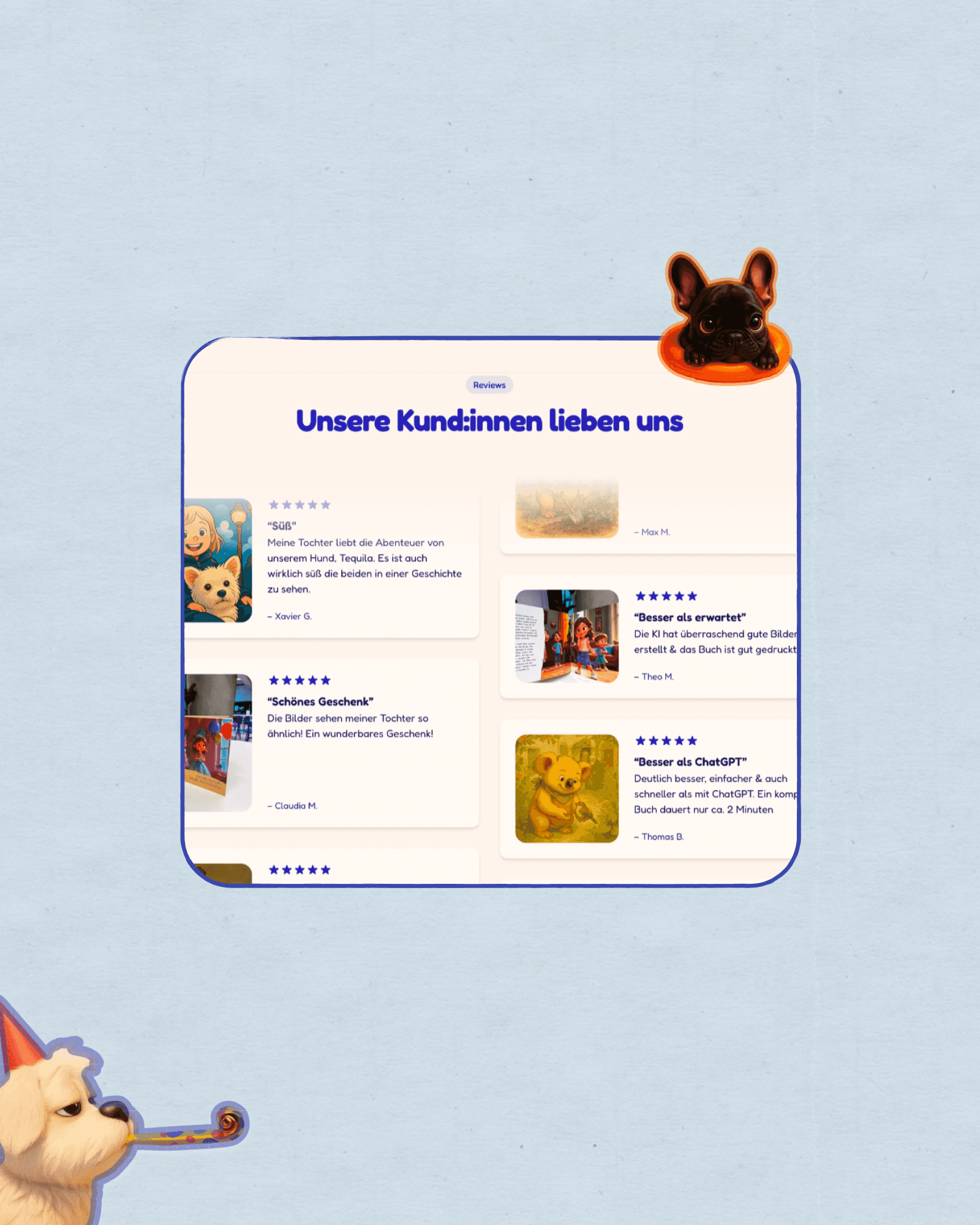
Product validation: Conducted live kindergarten readings of our books to gather first-hand child/parent feedback. Tested printed pilots with a few dozen families.
Commercial insight: Secured supplier partnerships & kindergarten association support, but realized that the model wasn’t well-suited for VC. While bootstrapping remained an option, financial constraints in the founding team made it unattractive. Having validated many hypotheses but unable to de-risk financing & revenue at scale, we decided to call it quits.

You might also like